
Vendor Portal Price Update on RFQ | Odoo Vendor Portal
v20.0
Purchases
Let vendors update shipment date and vendor price line-by-line from portal


Module index
Let suppliers maintain their catalogs, prices and availability directly through your portal.
Bring supplier products, price offers and reported stock into one vendor catalog. Vendors manage their own records through the portal, while purchase managers match offers to company products and compare availability across supplier locations.
Open Purchase Settings to enable the vendor portal and optional stock management. Enable Vendor Catalog on Portal on the vendor, then invite its contacts to the portal.
Screenshots illustrate the shared workflow in Odoo 20. Odoo 19 uses its native portal cards and backend controls.
Follow the workflow below from the first action to the result. Screenshots use demonstration records; the descriptions explain what to do, what the screen shows and which normal Odoo steps still apply.
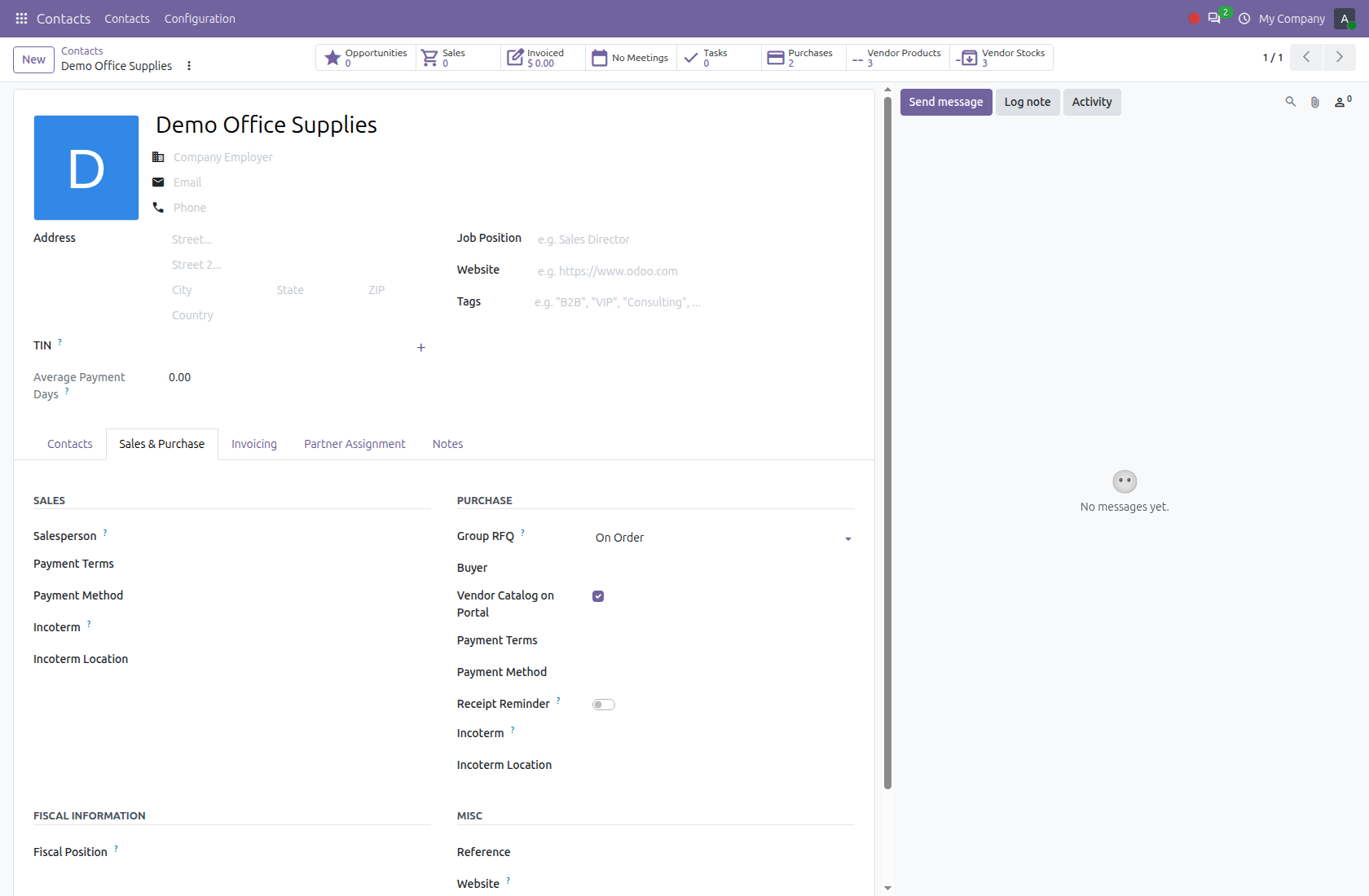
In Purchase settings, enable the moduleâs portal products and portal stocks options. On the commercial vendorâs Sales & Purchase tab, enable Vendor Catalog on Portal, as shown here. Give the vendor contact normal portal access and link it to that company. Internal buyers keep their regular Purchase permissions; the supplier does not need backend purchasing access.
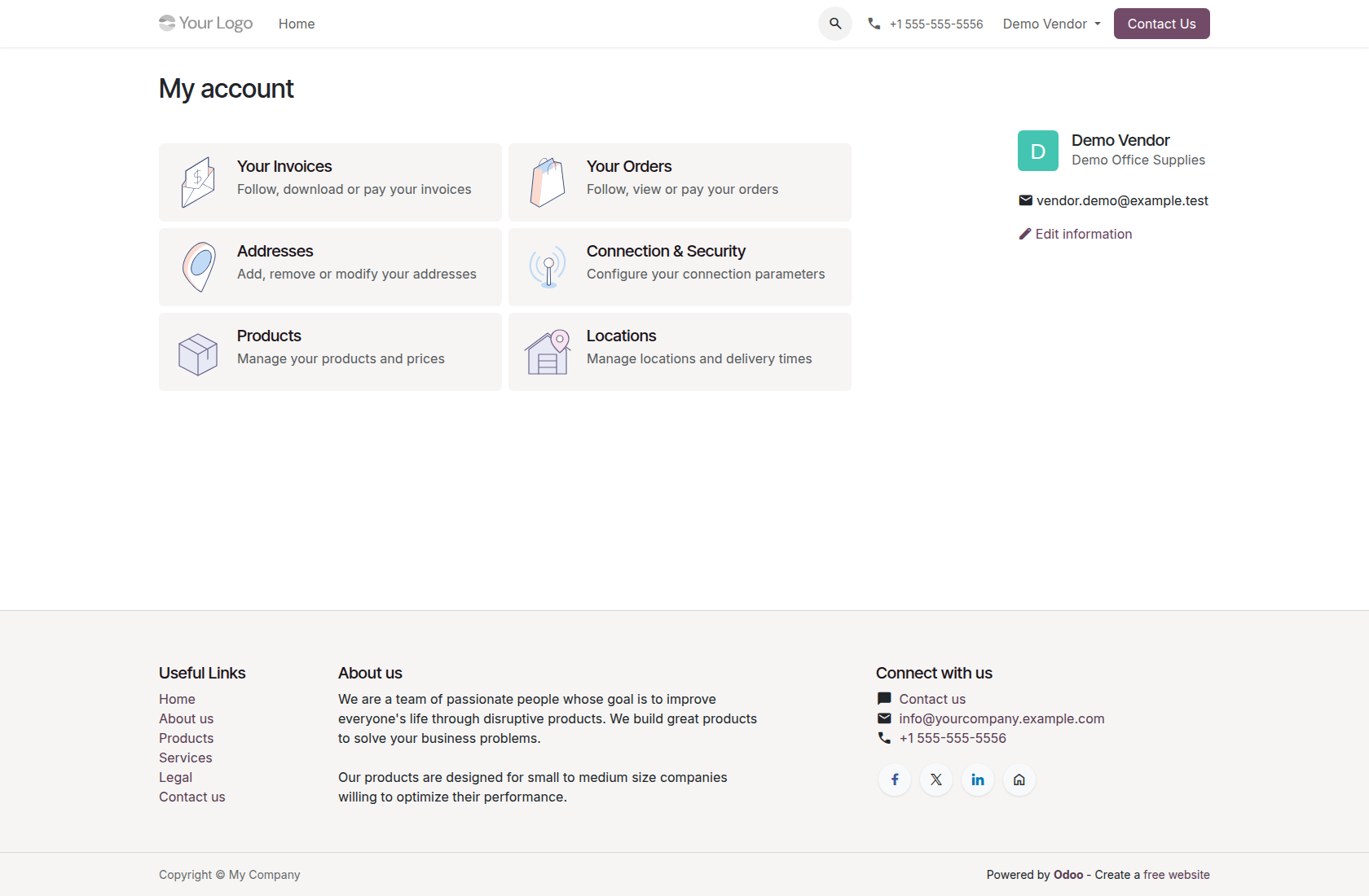
Sign in as the supplier and open My account. Products and Locations appear alongside Odooâs normal portal cards when the vendor is allowed access. Products opens the vendor catalog; Locations opens the supplierâs warehouses and delivery information. Each vendor works with its own companyâs permitted records.
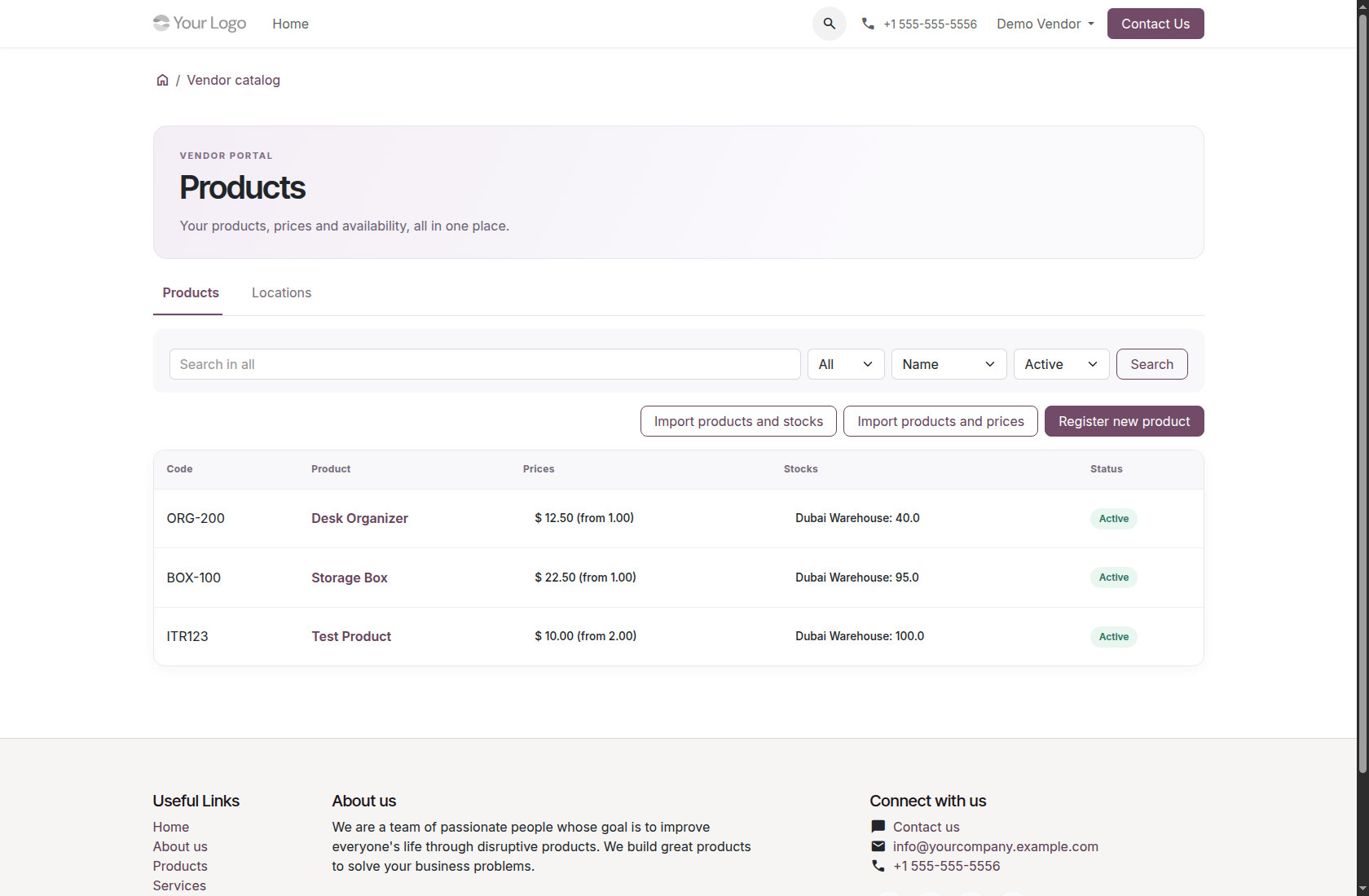
Open Products to review the vendorâs product codes, names, active prices, availability and record status. Search or filter the list to find a product, then open it to maintain its details. The remaining product-update examples use the existing BOX-100 Storage Box record; its demonstration price is USD 22.50 and its reported availability is 95 Units.
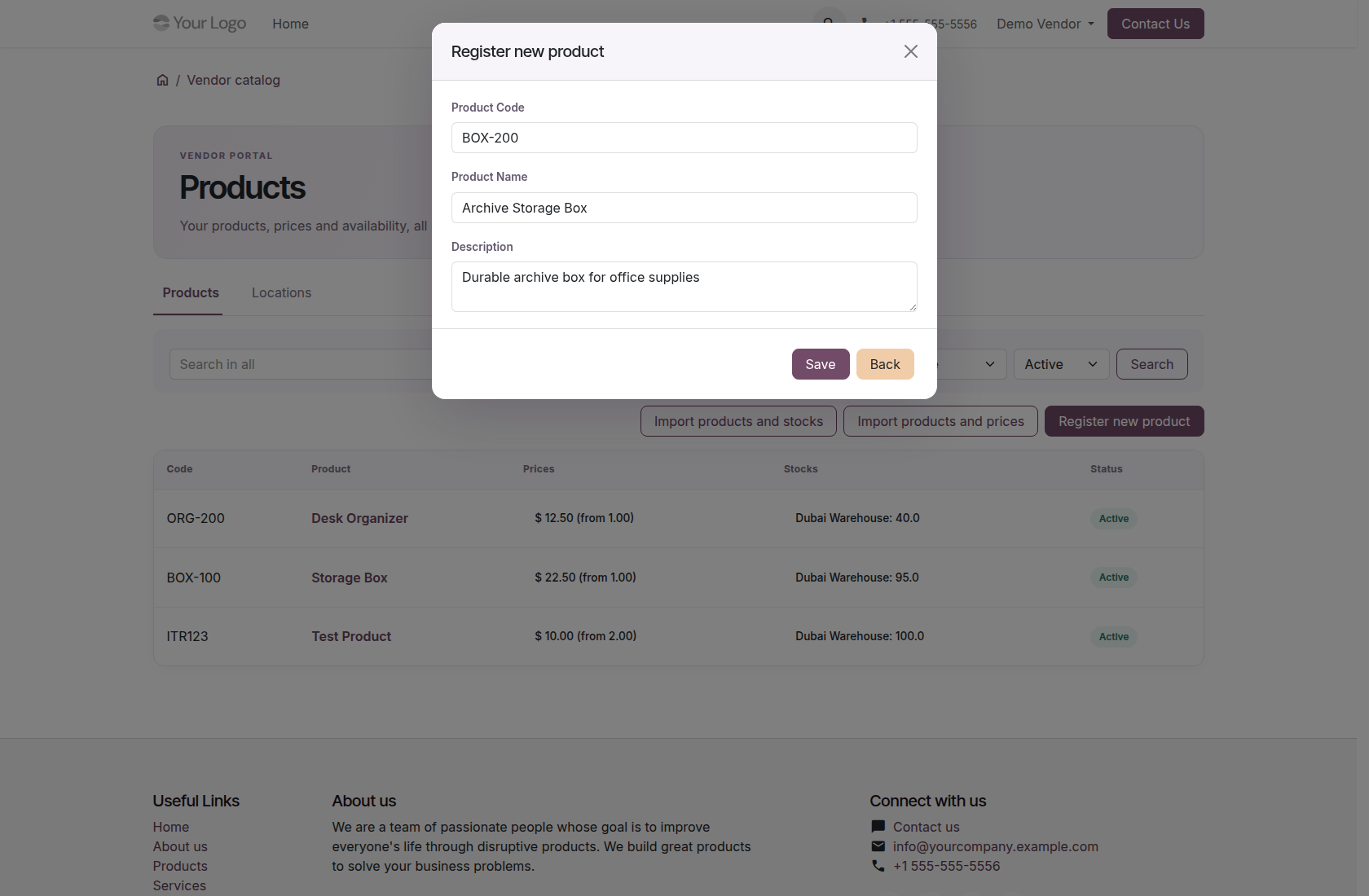
Choose Register new product and enter a vendor code, product name and description. The filled form demonstrates a separate new item, BOX-200 Archive Storage Box. Save creates that vendor catalog entry; it does not create or match an internal company product automatically. The following screenshots return to the existing BOX-100 example to show its price and availability workflow.
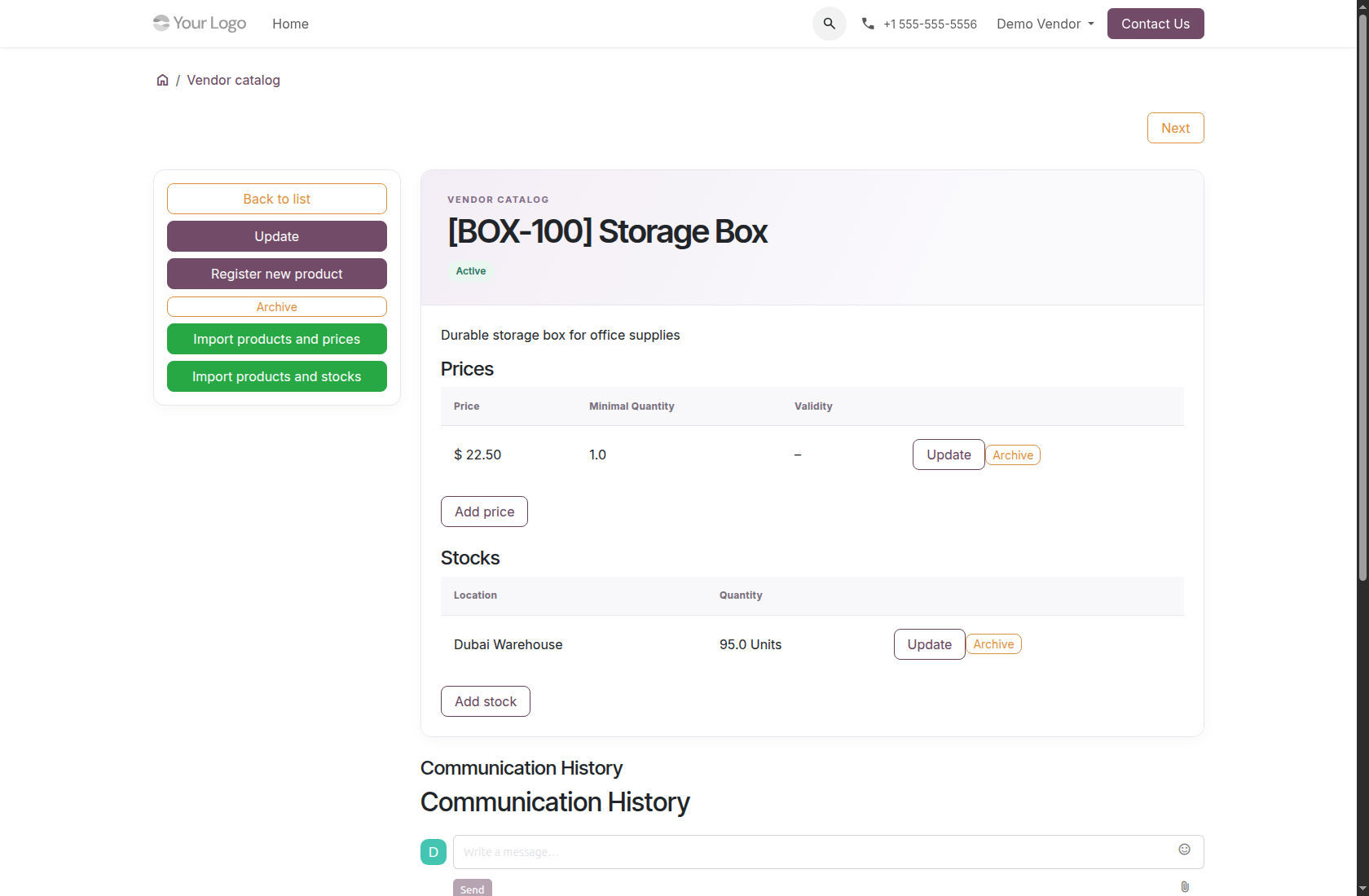
Open a catalog product to see its descriptions, price rows and stock by vendor location. In the BOX-100 example, the page shows USD 22.50 with a minimum quantity of 1 Unit, and 95 Units at Dubai Warehouse. Update the relevant row when an existing offer or stock level changes. Archive and restore controls manage the availability of catalog records without deleting their history.
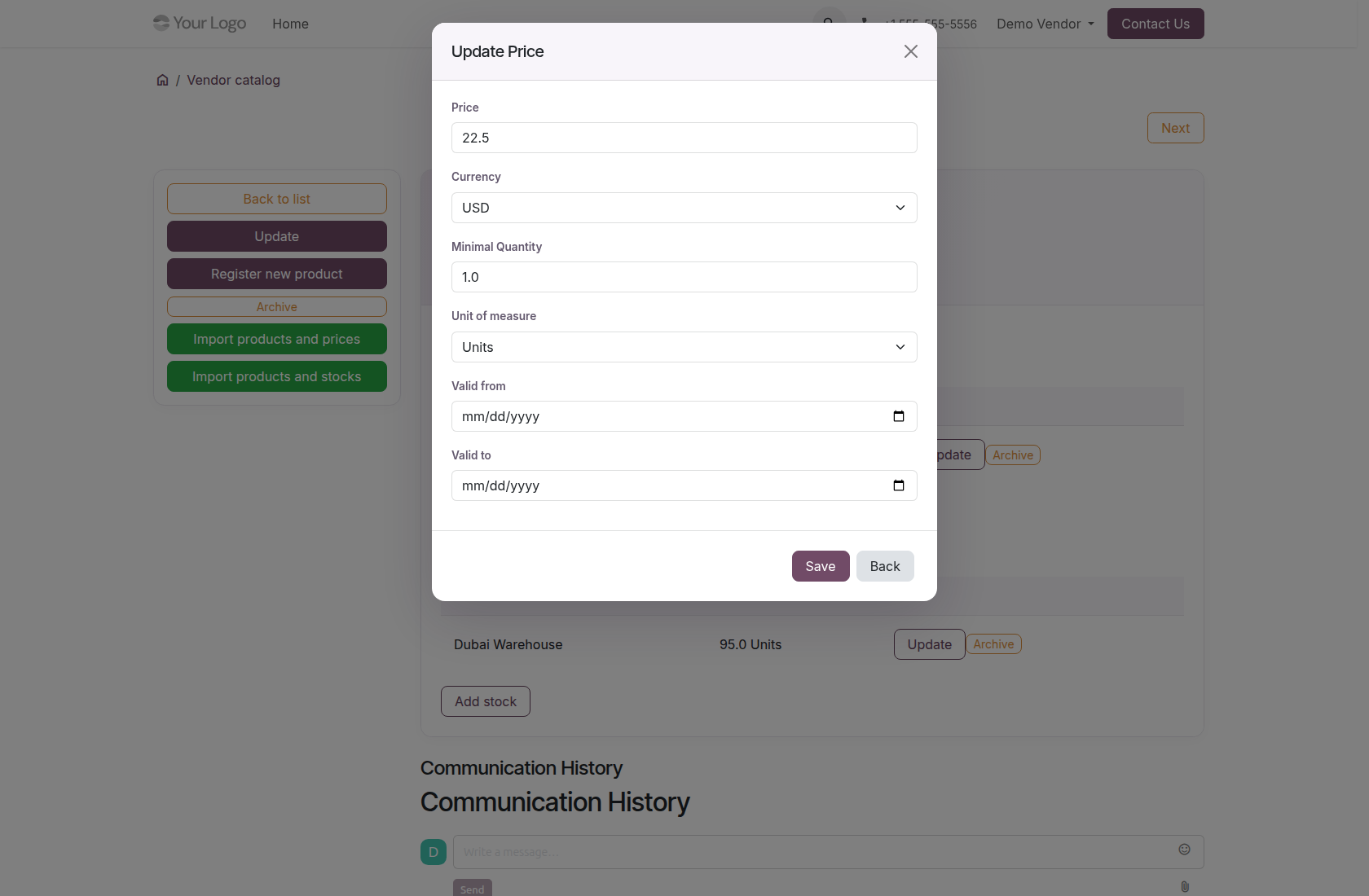
Use Add price for a new price row, or Update on an existing row to change that offer. Specify price, currency, minimum quantity, unit and any validity dates, then Save. The screenshot shows the existing USD 22.50 offer. Buyers need the correct vendor, currency, quantity, unit and validity period for that offer to apply to a purchase line.
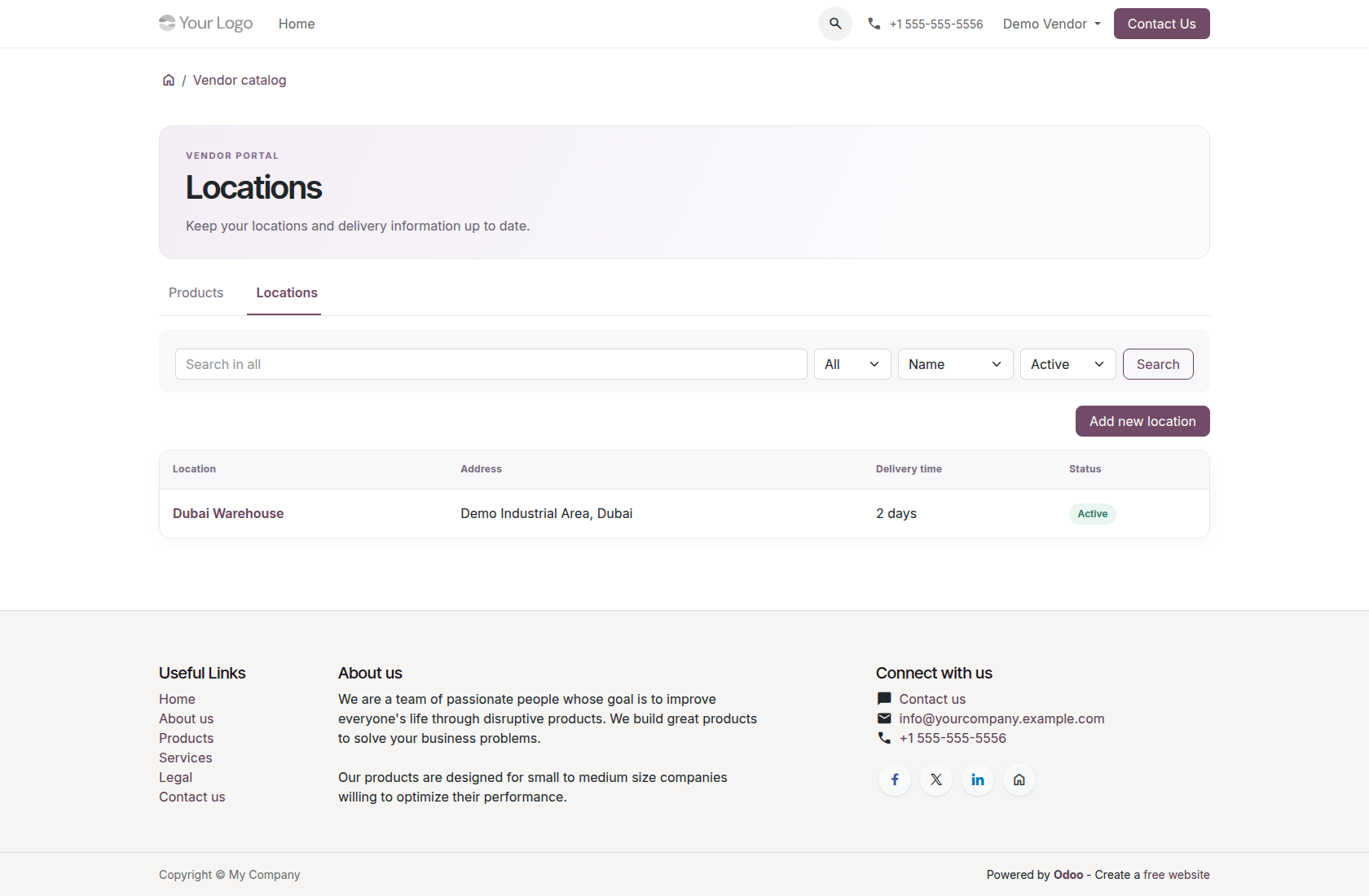
Open Locations to review or add the supplierâs warehouses. Maintain each locationâs name, address, delivery time and notes. Dubai Warehouse is the demo location used for the BOX-100 availability row. These are vendor locations for purchasing information, not internal Odoo warehouse locations.
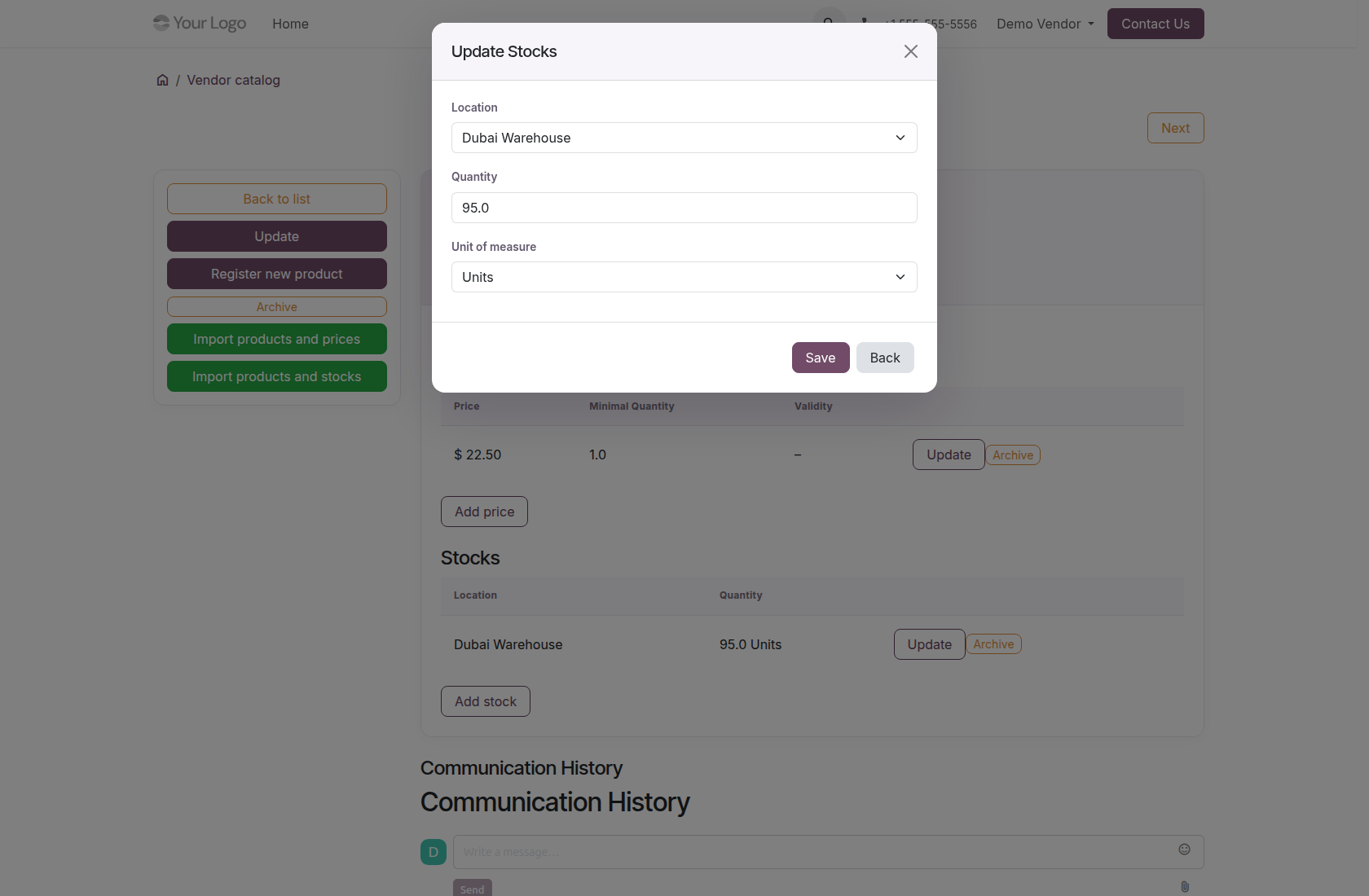
Use Add stock on a product, or Update on an existing stock row. Select the vendor location, enter the available quantity and its unit, then Save. This example reports 95 Units at Dubai Warehouse. Supplier-reported availability supports purchasing decisions; it does not increase stock on hand, create a receipt or move inventory in your own warehouse.
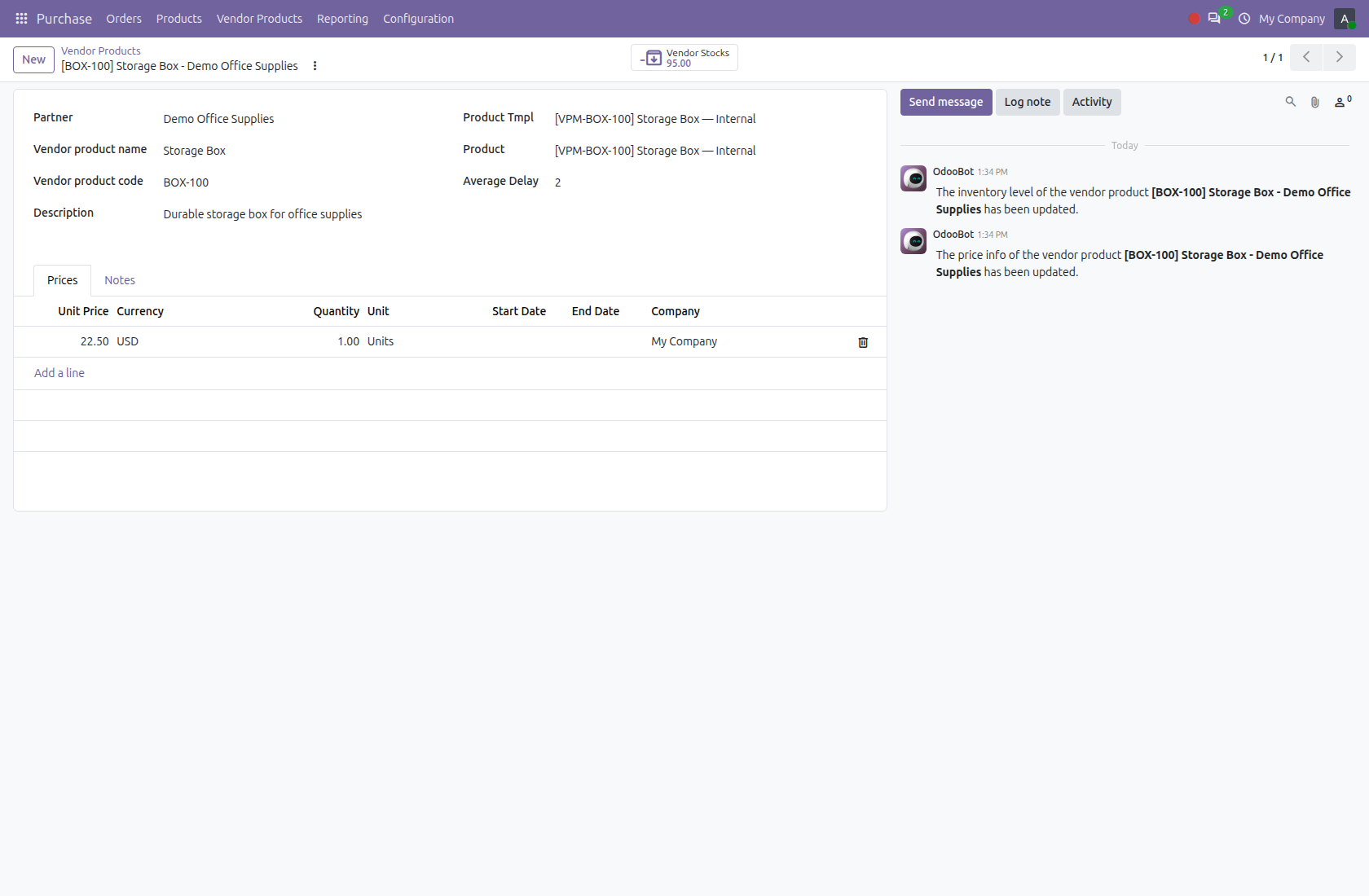
An internal buyer opens Purchase â Vendor Products â Products and reviews the catalog entry, supplier price and Vendor Stocks information. Match the entry to the correct internal Product Template or exact Product variant, then Save. The shown BOX-100 entry is matched to Storage Box â Internal. Internal matching is the buyerâs step; an unmatched supplier item does not supply a price for an internal purchase product.
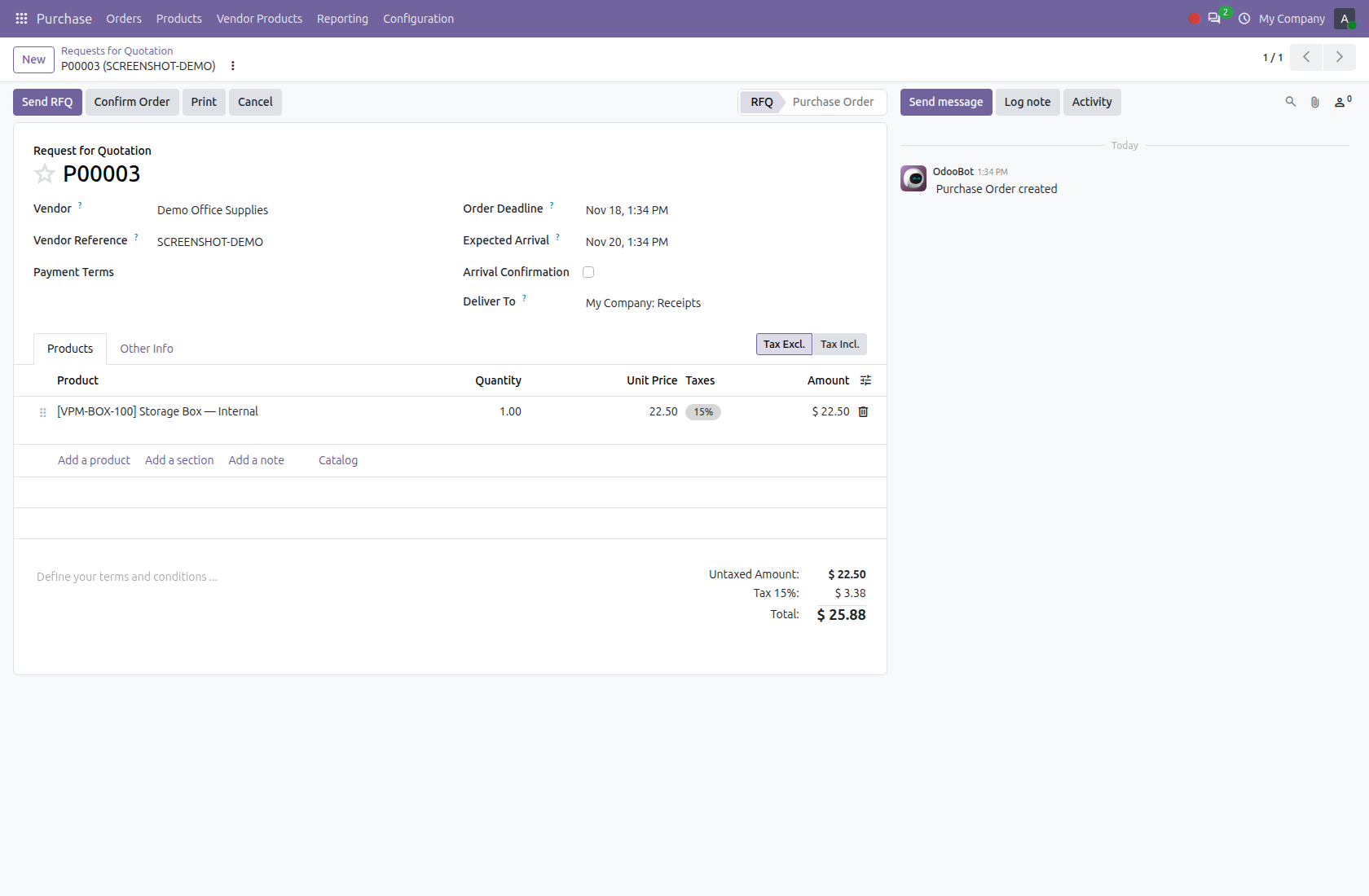
Create a new RFQ for the vendor and add the matched internal product. With the demoâs matching vendor, USD currency, quantity 1, unit and active offer, the line selects 22.50 per Unit before taxes. The screenshotâs total also includes the normal purchase tax. Updating a portal offer does not automatically reprice an existing RFQ: review or create a fresh applicable line.
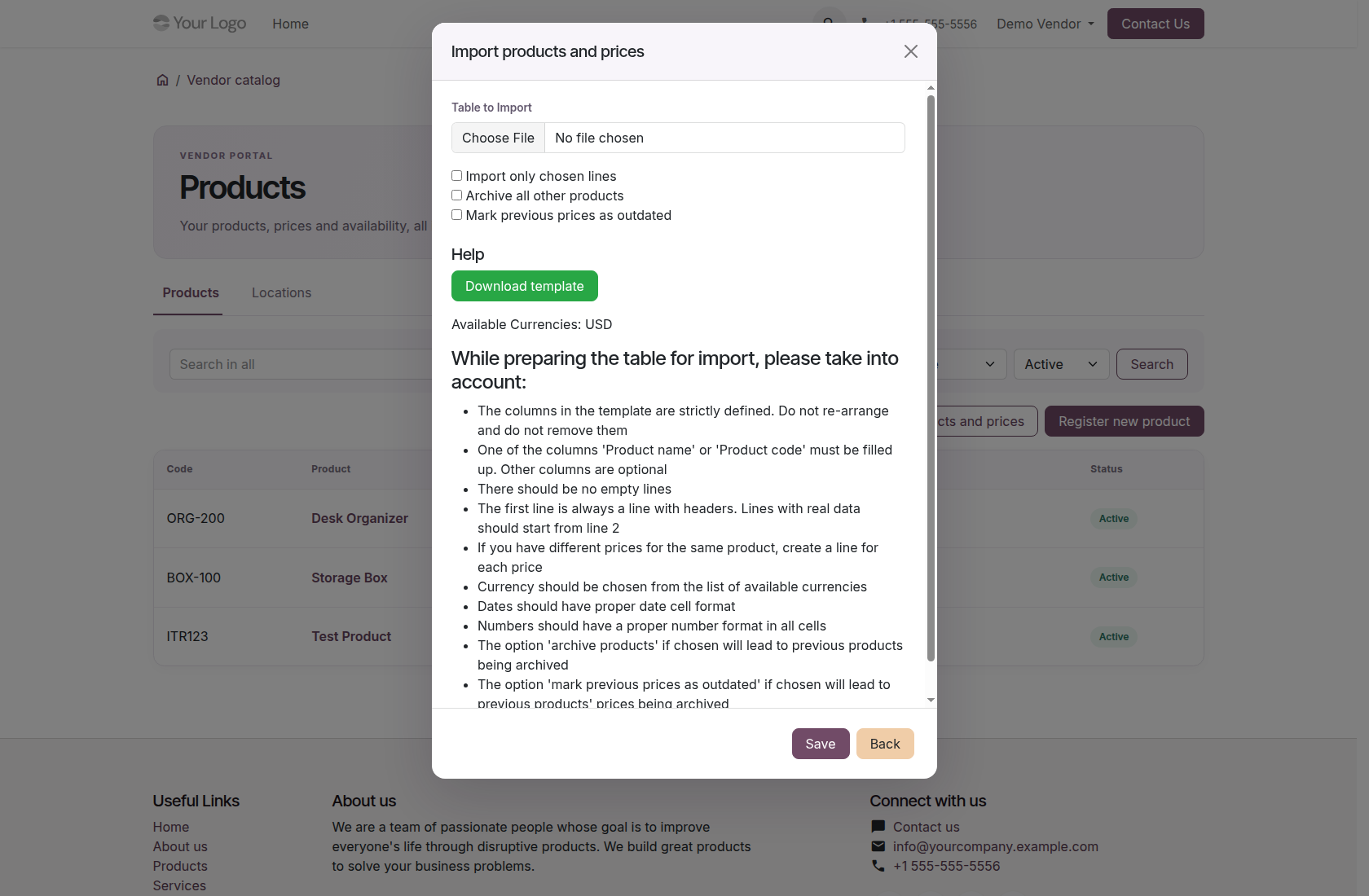
From Products, choose Import products and prices or Import products and stocks. Download the supplied template, preserve its column order, fill the spreadsheet and upload it. The dialog also lets the supplier choose a line range and optional archive behaviour. Select archive options only when they match the intended update. After an actual import, review its result summary and the resulting catalog records.
Legal
Odoo Proprietary License v1.0 This software and associated files (the "Software") may only be used (executed, modified, executed after modifications) if you have purchased a valid license from the authors, typically via Odoo Apps, or if you have received a written agreement from the authors of the Software (see the COPYRIGHT file). You may develop Odoo modules that use the Software as a library (typically by depending on it, importing it and using its resources), but without copying any source code or material from the Software. You may distribute those modules under the license of your choice, provided that this license is compatible with the terms of the Odoo Proprietary License (For example: LGPL, MIT, or proprietary licenses similar to this one). It is forbidden to publish, distribute, sublicense, or sell copies of the Software or modified copies of the Software. The above copyright notice and this permission notice must be included in all copies or substantial portions of the Software. THE SOFTWARE IS PROVIDED "AS IS", WITHOUT WARRANTY OF ANY KIND, EXPRESS OR IMPLIED, INCLUDING BUT NOT LIMITED TO THE WARRANTIES OF MERCHANTABILITY, FITNESS FOR A PARTICULAR PURPOSE AND NONINFRINGEMENT. IN NO EVENT SHALL THE AUTHORS OR COPYRIGHT HOLDERS BE LIABLE FOR ANY CLAIM, DAMAGES OR OTHER LIABILITY, WHETHER IN AN ACTION OF CONTRACT, TORT OR OTHERWISE, ARISING FROM, OUT OF OR IN CONNECTION WITH THE SOFTWARE OR THE USE OR OTHER DEALINGS IN THE SOFTWARE
Terms
By purchasing an app from OdooSphere, the customer agrees to the following terms.
All payments must be completed immediately through the website checkout. Orders are processed only after successful payment confirmation from the payment provider.
After payment confirmation, the purchased module will be delivered digitally as a ZIP file through email or the customer portal, where applicable.
Each purchased app includes 90 days of free support from the purchase date.
Apps are provided for the Odoo versions mentioned on the product page. The customer is responsible for selecting the correct Odoo version before purchase.
Since apps are digital products delivered after payment, purchases are generally non-refundable. Refunds may be considered only if payment was duplicated, the ZIP file was not delivered, or the app cannot work on the listed compatible Odoo version due to a confirmed issue in the delivered module.
The purchased app is licensed for use by the purchasing customer or company. Reselling, redistributing, publishing, or sharing the module with third parties is not allowed without written permission from OdooSphere.
Free updates are not guaranteed unless specifically mentioned on the product page. Bug fixes within the 90-day support period may be provided when the issue is confirmed to be caused by the purchased app.
OdooSphere is not responsible for business losses, data loss, downtime, third-party service issues, or problems caused by incorrect installation, custom changes, or incompatible modules.
Related modules
Reviews
Logged-in users can ask questions, discuss implementation details, and rate this module. Your rating updates the app score across the marketplace.